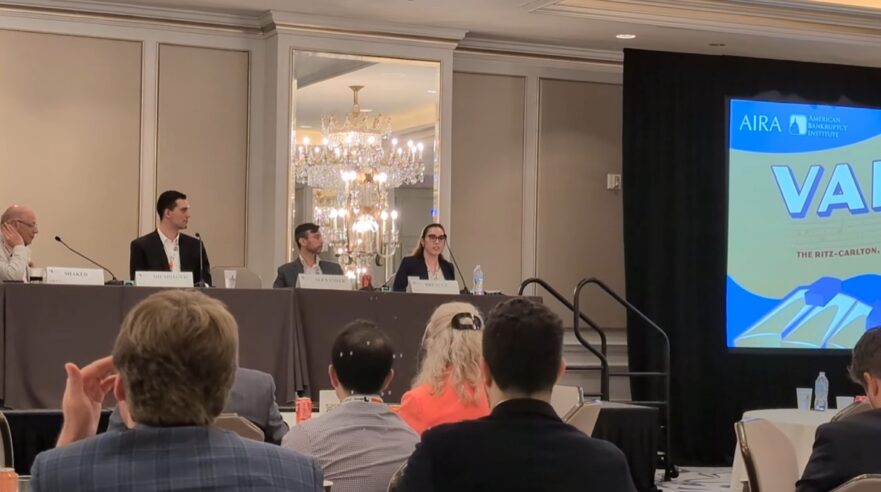
Coolidge Wall attorney Briana “Bri” Breault was a featured speaker at the American Bankruptcy Institute’s VALCON 2026 conference in New Orleans, where she presented on one of the most rapidly evolving issues in bankruptcy and restructuring: how artificial intelligence is changing the way companies are valued, investigated and administered in insolvency proceedings.
 Breault, an associate attorney in the firm’s Litigation and Bankruptcy Departments, participated in the panel “Risks and Benefits of AI and Impact on Valuing Companies.” Her presentation, “The Convergence of Artificial Intelligence and Insolvency: Navigating New Precedents,” explored a series of recent cases that are beginning to shape how courts and practitioners evaluate AI-driven businesses when they fail. Bri joined an accomplished panel of nationally recognized professionals and thought leaders, including: Dr. Israel Shaked, Luka Miladinovic and Abe Alexander.
Her topic may sound highly technical, but the implications are increasingly practical for companies, lenders, investors and legal counsel. Artificial intelligence has become a central part of many business models, and in some cases a significant driver of enterprise value. When those businesses encounter financial distress, traditional legal questions take on new complexity: What is the technology actually worth? Who owns the underlying intellectual property and data? Can those assets be sold? And how should attorneys use AI tools without compromising confidentiality?
“In bankruptcy, substance beats story,” Breault said, capturing one of the central themes of her presentation.
That principle is particularly important in an era of soaring valuations and aggressive marketing claims. Breault examined several recent insolvency cases involving technology companies whose stated AI capabilities and corresponding valuations collapsed under closer scrutiny.
In the bankruptcy of Builder.ai, for example, the company promoted what it described as a sophisticated no-code platform powered by artificial intelligence. Subsequent allegations revealed that much of the work attributed to AI was performed by hundreds of human engineers. The company’s valuation, once estimated at more than $1 billion, unraveled, and the technology that had helped fuel investor enthusiasm proved difficult to monetize in liquidation.
Breault also discussed Joonko Diversity, an AI-powered recruiting startup accused of fabricating customers, revenue and datasets. In that case, the bankruptcy estate generated value primarily through settlement rather than through the sale of technology assets. Together, these cases underscore a lesson with broad relevance: a compelling narrative may attract investment, but only verifiable, transferable assets create meaningful value in bankruptcy.
For clients, that insight has important consequences. Investors and lenders evaluating technology companies must look beyond marketing claims to understand what assets truly exist and how dependent they are on specific personnel, third-party licenses or proprietary infrastructure. Boards and management teams should be prepared to substantiate claims about technology and data. And businesses that use AI as a core component of their operations should understand how those assets may be viewed if the company faces restructuring or insolvency.
Breault also addressed one of the thorniest issues in the field: valuation. Proprietary algorithms, model weights and specialized datasets often lack a robust secondary market, making it difficult to determine what they are worth in a distressed sale. Drawing on precedent from the FTX bankruptcy, she explained how courts may apply substantial discounts for illiquidity and lack of marketability when assets cannot be readily transferred or sold.
Her presentation emphasized that successful recoveries in technology-focused bankruptcies require both traditional insolvency skills and sophisticated technical due diligence. Determining whether an AI asset has practical value often depends on understanding how the technology was built, whether the company owns it outright and whether a third party could use it independently.
Breault also explored the ethical considerations surrounding attorneys’ own use of generative AI. As law firms increasingly adopt AI tools for research, drafting and analysis, lawyers must remain mindful of confidentiality obligations and the possibility that information entered into public platforms could compromise attorney-client privilege.
Breault closed with a broader observation about the role of the courts in testing the claims that surround emerging technologies: The federal judiciary has become the ultimate arbiter of truth as the ‘AI bubble’ encounters the rigor of the Bankruptcy Code. Her participation in the ABI VALCON 2026 conference is especially notable given the national caliber of the conference and the panel itself, which often features attorneys and advisors from some of the country’s largest firms and institutions.
Her presentation reflects the practical, forward-looking counsel that clients increasingly need as artificial intelligence becomes embedded in business strategy, valuation and risk. Whether advising lenders, investors, corporate boards or companies navigating financial distress, attorneys must be prepared to assess not only what a technology promises, but what it is worth when subjected to legal and financial scrutiny.
Briana C. Breault is an associate attorney in Coolidge Wall’s Litigation and Bankruptcy Departments. She represents businesses, creditors and other stakeholders in complex commercial disputes and insolvency matters. Her practice includes bankruptcy litigation, creditors’ rights and business disputes, with a focus on helping clients navigate sophisticated legal issues in a rapidly evolving business environment.